


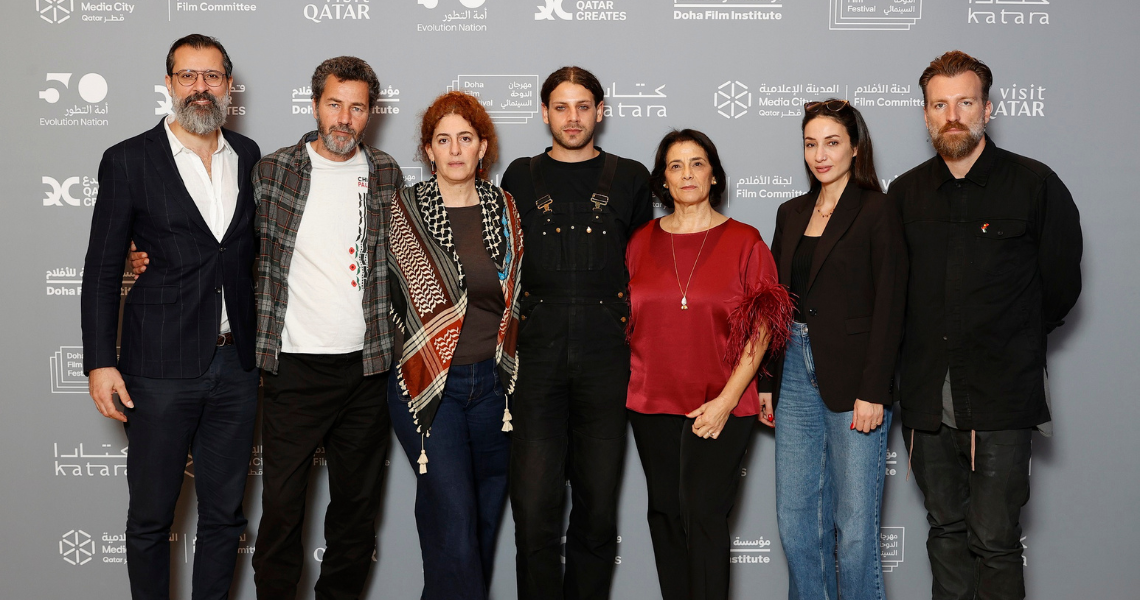
Palestine 36 presents a living archive of a defining chapter in history, said director Annemarie Jacir, following a special private screening of the movie at Doha Film Festival.
A landmark work that brings to life the 1936 revolt during the British Mandate for Palestine, the film integrates a dramatic narrative with painstakingly restored and colourised archival footage.
“The revolt of 1936 is our first mass uprising, cutting across classes and geographies,” said Jacir. “Much of what we live under today was designed then. We wanted the archive to feel present and alive, not a step back in time, so viewers experience a continuous, forward-moving story of people asserting dignity and agency.”
Built on years of research and field work, the production team restored a partially destroyed Palestinian village using traditional methods, in close collaboration with local families, before conditions forced the crew to relocate and rebuild the set-in northern Jordan. The film also features sequences shot in Jerusalem, captured under intense physical and emotional pressure.
“We felt we might never be able to return,” Annemarie said “Filming Palestine 36 became an act of preservation of places and lives at risk of erasure. It was clear we might never come back. We filmed under duress because memory itself was at stake.”
Reflecting on her role in the film, Hiam Abbas said: “There is no way to separate my artistic identity from who I am and what Palestine left in me. That inheritance is the emotional system I work with.”
Co-produced across the wider region with post-production completed in the UK, Palestine 36 reflects deep regional collaboration, with Doha Film Institute supporting the film. “Every film adds to the memories we are striving to preserve,” added actor Saleh Bakri.
Composer Ben Frost’s original score anchors the film’s emotional core, responding to images of a world “gone forever” with a soundscape of loss, resilience, and memory. “The music is my honest response to a sense of loss.” The score was recorded in Doha with the Qatar Philharmonic Orchestra.
Closing the discussion, Jacir said: “This film is, at its heart, made by Palestinians who built it together under impossible conditions. At its heart, this work is Palestinian, and I am very proud of that.”
For more information, visit www.dohafilm.com.